Bucketful Of Memories
Introduction
For Christmas 2002 my daughter, Debbie, gave me a half-gallon container filled with small strips of paper of various colors. Each small paper is printed with a sentence or two describing some detail she remembers from our shared times together. It was suggested that I read one each day. I keep the container near my computer so I'm certain to see it and remember each day to read one. Several times since then (it is now January 11, 2003) I've been tempted to sit down and read through them all at once. I haven't yet.
I've read enough of them to begin to treasure them. I realized that if my grandchildren ever had the opportunity to read them there are many that they'd not understand. There may be a few where I'd like to record my version of the story. And in some cases, I want to record my own thoughts so that when I'm really old and my memory begins to fade I'll have something to remind me who I was.
The Memories
I still have one of the DHL bags you gave me.
During the first half of the 1980s I worked for DHL Airways. They provided lightweight nylon document pouches for their regular customers. These were color-coded to designate their destination city, making rapid sorting at transfer points easier. DHL allowed employees to purchase some of these pouches for their personal use.
DHL Airways (https://www.dhl.com/en.html)
Remember the Cobblerator?
Indeed I do! Debbie and Jamie spent the summer with Carol's parents on a ranch south of Lund, Nevada. When they returned to Ketchikan Debbie was proud to demonstrate that she had learned to make fruit cobblers. I went to work about 5:00 p.m. and got home while she was sleeping, and she went to school before I woke up in the morning. One night I returned from work and found a fresh cobbler she had made, with a note from Debbie inviting me to enjoy a piece of it, which she signed "The Cobbler-maker". I ate a piece of the cobbler and added to her note something like "I did. It was yummy. Thank you." and I signed it "The Cobbler-ator".
Lund, Nevada (http://lund.whitepine.k12.nv.us)
Ketchikan (http://www.city.ketchikan.ak.us/)
I remember when you jumped in a creek at the park during a picnic to save a little girl that had fallen in.
That's a lovely story: it makes me seem heroic. The child was under water and floundering, apparently unable to get up. However, the stream was not more than about a foot deep and three feet across and was not running especially fast. I waded into the water, picked up the girl, and handed her to her mother. I didn't really do anything to get excited about. It reminds me of how our perception of objects and events changes as we mature. Houses, cars, and other things that I remember from my childhood years are always smaller and less significant when visited again after decades of absence.
I remember Lizzy laughing so hard at the dinner table that she almost threw up on you.
I may not remember this specific incident. I do remember a time when Liz ("Lizzy" was a name not quite dignified enough for a young lady, I suppose: I often called her Elizabeth) was sitting on the couch in our living room enjoying some milk and cookies. She had just gotten a mouthful of milk when someone said something funny. She doubled over in a fit of laughter, but not until she managed to spew the mouthful of milk across the room from both her nostrils and her almost-sealed lips — and we all laughed even harder. I suspect she felt embarrassed a little while later, but not terribly so.
I remember getting to ride in your DHL van that had no seats in the back.
DHL (https://www.dhl.com/en.html)
No you don't! Ummm... it's a good thing there was a passenger seat in the front, isn't it? After all, I would never do anything as foolish as to allow someone to ride in the cargo compartment.
I love the way that you can think of a song for almost anything.
This is one thing I've not thought of a song for (yet). [Carol suggested one: "You Can Smile (When You Can't Say A Word)" — that seems like a good choice.]
I really miss the time we had when you drove me to school in Modesto on your way to work.
Modesto (http://www.modestogov.com/)
Good times. Listening to the news and discussing the problems of the day (sometimes from around the world, sometimes from around the house).
I remember one year at Christmas time I played my flute at church, and you told me that I did a good job, and that meant so much to me.
Yes, I remember that too. It was a good job.It was also probably a rare occurrence for me to say so; I felt that praise is devalued if given indiscriminately. I tend to set fairly high standards for myself (and others) and consequently did not give (or accept) praise nearly as often as I probably should.
I remember the first time you let me drive on the freeway in Granny's van and I almost sideswiped a school bus.
Mercifully, I don't remember the school bus specifically; though I do remember that day and that I allowed you to drive on Interstate 280 from Woodside to about Cupertino. I don't usually get excited or upset easily, but teaching a teenager to drive is enough to get my blood stirring a bit.
I remember how hard I worked on your 25th anniversary party, and how fun it was to arrange that for you.
Thank you. We were surprised and delighted.
I remember when Pikey would sit in your lap and look at pictures on the computer with you.
It's a good thing I had a collection of planes, trains, and automobiles because he wanted to see cars — he'd tolerate pictures of people he recognized, but only briefly.
I remember when you laughed at my Ugly Duckling Christmas tree before it became a Beautiful Swan.
Amazing how a little work and a whole lot of love can transform things!
I remember when you taught me how to make peach syrup.
How important such lessons are! yet I do not remember teaching this one. I remember making peach syrup many times, and surely there were a few of those that were "joint projects" — but I don't remember a time when we said "Okay Debbie, it's time for you to learn this". It seems to me it was just a natural byproduct of living and working together. By the way, peach syrup is such a delicious treat and such a simple one to make for yourself that it should probably be a crime for families not to do it at least occasionally.
Your Father was wrong, you are not useless. You are one of the hardest working people I've ever known.
Thanks. I work best on the things I enjoy doing.
I love the way your eyebrows shoot up when you're trying not to laugh.
So I shouldn't try to become a professional poker player?
I remember when you used to use your little TRS-80 to keep score at hand and foot.
Even though I'm allergic to paper and pencil, that's what I use these days to keep score. There is nothing so complex about the game or its scoring that requires the use of a computer; I simply enjoyed the challenge of writing the program (besides, most folks said they'd rather let the machine keep score). Since you brought it up, and this is about memories, we've got to at least tell folks that it was a TRS-80 Pocket Computer PC-3. If I look in the closets here I can probably still find its successor (a PC-8) and its printer/cassette interface.
allergic to paper and pencil (dysgraph.gmi)
hand and foot game (http://www.pagat.com/rummy/handfoot.html)
TRS-80 Pocket Computer PC-3 (http://oldcomputers.net/trs80pc3.html)
Sharp Pocket Computer PC-1251 Resource Page (https://edgar-pue.tripod.com/sharp/pc1251.html)
I remember using your used up deodorant sticks for perfume.
Little girls are so silly. Sadly, I also remember that during the time I worked nights the "silly little girls" at our house missed their Daddy at bedtime and were sometimes comforted by the "perfume" smell that reminded them of me.
Thank you for emphasizing the importance of having a healthy spiritual life.
You're welcome. We look forward to seeing you and your family at Sunday School and church next Sunday. ;-)
I remember hanging out with you in the KTN office in the Mary Frances Towers.
Mary Frances Towers (https://www.facebook.com/pages/Mary-Frances-Towers-Condominium/154557004581903)
I'm sorry. Oh yeah, you sort of liked it sometimes. But hanging out at Mom and Dad's office isn't really fun, at least not if you have to do it often or for long periods of time. Still, even things like this build lasting memories and teach useful lessons about life and work. Take your kids to work with you occasionally; just remember that they're kids. "KTN" was the local delivery business that Carol and I operated for several years.
I remember how we named "Granny Salad" because you said that cottage cheese is little old lady food.
That's right! and as long as I have teeth I'll eat meat and potatoes. For those that don't know: Granny Salad is made from gelatin dessert, cottage cheese, and whipped cream (all the little old ladies at the potluck dinners seem to love it) and it belongs to the basic food group called "goo" (along with a large collection of sauces and severely overcooked vegetables and pasta — all suitable for toothless old folks).
I remember that you used to put hats on you and the kids and take them to the park, and what a relief that was for me.
Thank you! Yeah, Noah knew that if I put on a hat on there was a good possibility we were headed for the park (in those days I seldom wore a hat for any other reason). Of course, if you have a solar-powered brain like I do, a hat is essential equipment to protect your solar panels from over-exposure when you're planning to be outdoors for a while.
And I knew that if you left the front door ajar he'd go to the park without a hat, and even without Papa. I don't think he could say more than a few words, but he could navigate the two or three blocks from our house to the park with no help at all. The other kids soon learned how to take Papa to the park too.
One of the saddest days for me was when you moved to Cape Girardeau. We drove through town saying goodbye and as we passed Barrington Park Noah waved and said "goodbye, blue park". It seemed as though we might never be together again.
Cape Girardeau (http://www.cityofcapegirardeau.org/)
I remember when you came to visit and we had Thanksgiving early.
Oh yeah, now I remember. You borrowed a roasting pan from your neighbor who wouldn't need it until two or three days later.
An interesting thing about memories: It is primarily the exceptions that allow us to differentiate among multiple instances. We've eaten many meals together, you've prepared many of them for me, and that is especially true for the meals I've eaten at your house. I've even shared multiple holiday meals at your house. The only way I was able to remember the event you're talking about (which was only a couple of months ago) was to remember something unusual about it.
I can't remember for sure now why we were there that weekend — I'm pretty sure that it wasn't just for the holiday meal; we were visiting my brother or.... Oh! now I remember: Felicia was coming back from Michigan and we needed to pick her up at LAX airport. We stopped at a yard sale and Felicia and Carol bought that pitiful Christmas tree that took two days to be transformed in a massive whole-family arts-and-crafts project.
Thank you! for helping me remember.
I remember going sledding on your lap on the Govaars' toboggan and when you put your feet down to slow down, snow would spray up.
Pretty cool, huh? There are advantages to being more than four feet high: most of that snow spray misses your face.
I've got to turn the tables a bit: I remember that I once timed the rotational speed of the turntable in the microwave oven while I waited for my drink to heat. I announced the result of my calculation (3 rpm) to my adoring family members nearby; Debbie immediately said "Dad, you must have been really bored." I responded with a quote from Ellen Parr: "The cure for boredom is curiosity. There is no cure for curiosity."
quote from Ellen Parr (https://quoteinvestigator.com/2015/11/01/cure/)
I started to marvel at the minutae (the snow spray) that we sometimes notice and remember, and wonder why you noticed it and remembered it and I did neither. But all the world is filled with things worthy of our wonderment — especially when you're young — and our lives are much richer when we learn to notice and remember them. A major component of "intelligence" is the ability to recognize patterns (or create them — ask me about the distinction and why it might be important) and that requires a body of raw material (observations) with which to work. Be always curious.
I remember when we went for walks in Ketchikan.
I don't remember doing this very often, but we did stroll along Shoreline Drive on enough occasions that I can't distinguish any of them from the others, with this exception: Michelle Konet was visiting us on one of these occasions and we went out for a stroll after dark. She was quite young and preferred to be carried; but she could be encouraged to walk along with the rest of us if we had her try to "catch" a spot of light projected on the roadway from my flashlight. She danced merrily along trying to step on the spot of light, which never quite seemed to stay in one place long enough. Even this diversion wore off after a few minutes and one of us had to carry her for most of the remainder of our walk.
How do you catch a bird by salting its tail?
Why, it's simple (just ask Simon): after you've salted its tail you have but to reach out and pick it up. How old was Debbie before she realized that I wasn't serious when I told that; how old was she when she gave up trying to figure out the scientific principles involved? I'll not say here. Perhaps this fellow will help you understand how it works.
Simon (https://web.archive.org/web/20011027120546/http://trmg.designwest.com/TRMG2.html)
Another story from Tom Are, this time from his childhood, which may illuminate from where his parenting methodology comes.
"Every father knows, not every Father tells, but every father knows that the only way to catch a bird is to sprinkle salt on the bird's tail." Tom told his father that he wanted a bird. "'A bird,' he said. 'Great day son, we already have three cats, two dogs and a yard full of squirrels, what do you want a bird for?' 'Not a pet store bird Dad. I want that blue one in the backyard.' He smiled a little, 'well sure son, all you have to do is take this salt shaker, sprinkle salt on his tail and then he can't fly. You just scoop him up, bring him inside, give him to your mama.'
"There is a flaw in this system. The bird seldom poses for this exercise. I chased that bird all spring. I would have killed the grass in the back yard if I had been a little more persistent. Soon I changed strategy. I built a trap. I got a box. Propped it up with a stick. Underneath the box I put peanut butter, and twinkies, kool-aid, and bananas. I tied a string around the stick and hid behind the garage, and I waited. Several birds flew down and hopped around, but finally a Blue Jay stepped under the box. I pulled the string, the stick came out, and the box came down. I had a bird. He was the maddest blue jay in Alabama, but he was a bird. I had put the box on top of a window screen, so I flipped the whole thing over, and I had the box, the bird in the box, the screen on top of the box, and I was standing there with a whole box of 'when it rains it pours.' I got salt on that bird's tail. I got it on his wings, his head, his back; I just chased him around the box.
"By the time I emptied the saltbox that bird was knee deep in salt.
"I opened the screen, just that much. Tom's daddy lied to him. That bird flew out of there so fast I didn't even see him. I could trap the bird. I could salt the bird. I could put him in a cage and keep him in my room. What I could not do is change the fact that God made the bird to fly."
Excerpted from Sermon Preached by Doug King Sunday September 29, 2002
Actually, Debbie expressed her disappointment to me years later: she had trusted me to be straight with her. I wasn't in the habit of tricking or teasing anyone, and she really thought that I had given her valid information and that she had failed to understand it. She perceived failure or weakness in herself, rather than recognizing that the failure was mine. We both learned valuable lessons from this experience, but I'm not convinced that it was a good way to teach them.
I remember when you hid an Easter egg in your pocket and it took us forever to find it.
Yeah, there ought to be a rule about that: "Eggs may not be concealed upon the person, they may only be hidden in, on, under, or behind inanimate objects".
Perhaps you learned to examine your unwritten rules — the assumptions we all make about how the world works — and look beyond the expected. Of course, you were young and that is some pretty sophisticated thinking; more likely you were thinking that Daddy doesn't play fair. Is it too late now to learn new lessons from old memories?
It's a shame that you and most of the world don't realize that you are one of the world's Great men. You just didn't get famous.
Welcome to my Fan Club. I'll be sure to send you a membership card and a secret decoder ring if I ever have any.
I suspect that greatness is in some ways like beauty — it is found primarily in the eye of the beholder. I see no need for fame in order to be truly great. If one is great, that will be true regardless of who notices and who doesn't.
I was certainly not left speechless by this "memory", but much of what comes to mind was first said by others.
- [W]hoever wants to be great among you must be your servant... – Jesus (Mark 10:43)
- Fools' name and fools' faces are often seen in public places. – often repeated by my grandfather
- I'd rather have Jesus than world-wide fame; – Prince Oscar Bernadotte
Prince Oscar Bernadotte (https://library.timelesstruths.org/music/Id_Rather_Have_Jesus/)
I remember how beautiful it was when we drove through Yosemite.
I've already written a bit about our travels through Yosemite.
I don't think we have any photographs; we'll have to write word pictures and rely on our memories to reconstruct those images.
But your note caused me to remember another beautiful trip we shared, though I doubt you will remember it specifically (I only remember it as one of a long series of similar events, that is: I can't tell you the exact date). You were driving me home from work, probably in your car though I don't even remember that much detail. We were driving down Carpenter Road and River Road as we had hundreds of other times. I watched the sun getting lower in the sky, the sharp-skinned hawks on tops of telephone poles, the corn and alfalfa fields, the Holsteins, the alternating left/right pattern of the middle of the three wires on power poles — all the things that we had seen so often and the kids were bored by. I noted the passage of the landmarks, all the things I miss when it's really foggy: the canal, Whitmore Road, the almond huller, Service Road, the mobile home park and canal and power transmission corridor right next to each other, Grayson Road, the school, then the rebuilt house just north of Keyes Road where I found you and your family stranded in a broken-down car once, the bend at Taylor Road, the section where there are no telephone poles between Monte Vista Road and West Main, then Ruble Road, the hatchery, the smelly factory, the dairy where the road bends and bends again, and the sportmen's club at the south end of Carpenter.
I remember this day among all the others because you were driving; it was a special blessing because I was tired and I especially enjoyed being able to relax and watch. I remember this one time among hundreds also because I sat there and watched all those familiar things pass by outside my window and I imagined what it might be like 20 or 30 years into the future, when I might be unable to see and you were driving me along the same road. I could feel the warmth of the setting sun on my cheek and I could ask you to describe the hawks and the Holsteins, "have we passed Monte Vista yet?", "are the orchards in bloom?", "how high is the corn?", "is it clear enough to see the mountains?" — and you are gracious and drive me when I am tired and you describe all those old familiar things for me again.
Yes, I remember that trip, and I remember the comfort of thinking that even if I am old and feeble you might help me remember all these things; and you have. Thank you.
Thank you for loving me enough to sweep my front porch when I had too much to do.
You're welcome.
There is enough desert sand being blown there by the wind and the kids and the dogs that trying to keep that patio swept clean could be a three-times-a-day task. But the wind was not excessively hot or cold that day, and the kids were busy somewhere else; it was a fairly pleasant task.
I remember when you would come to our concerts and plays at school.
school (https://hte.kgbsd.org/en-US)
Goodness! That seems so long ago. And I also remember a dramatic production or two in the Little Theater at North Salinas High School. I can't say that I was looking for an evening of fine entertainment, or even for an excuse to get out of the house. I guess I was there mostly because you were.
North Salinas High School (https://www.salinasuhsd.org/Domain/15)
I remember when you first showed me a moebius strip.
I don't. But they're still pretty cool. Are they a child's plaything or a math teacher's dream? They've caused me to think quite a bit over the years, though I can't say that I've ever developed an understanding or appreciation of the mathematics involved. Teach your children, even if they don't understand it they'll still be impressed — and it may spark some more curiosity, which can lead to more learning and more good stuff after that.
Thank you for staying married to my mom, and the security that provided for us.
Hmmm… I don't think I've ever considered not being married to her, at least not as a voluntary choice. I must confess though that my commitment to our marriage was never based on wanting to provide a secure environment for our children. It has always been largely a case of "social security" for me: as long as we are married my social life is stable and secure. As much as I dislike change, I appreciate having a stable, secure relationship. Of course, she has been my best friend through these 30 years and we continue to grow closer as time passes.
I care very much about her; that you benefitted from our relationship is a wonderful side effect. You must know, though, that you and your sister are more than a side-show or a serendipitous blessing that came our way. You are loved as a separate, valuable person totally independent from your mother and sister. Yet, perhaps paradoxically, we share a distinct bond as a family (the four of us) that is different and separate from the individual relationships among us.
In any case, I'm glad that we've shared our lives together. Thank you for noticing.
Thank you for not letting us out of the driveway until we knew proper bicycle safety.
I doubt that it seemed such a good idea to you at the time. The way I remember it, I was more concerned about proficiency in operating a bicycle than knowledge of all the rules. Yes, we taught you where to ride, how to signal a turn and the rules that cyclists and motor vehicles were expected to follow. But you still weren't allowed to ride in the street until you could ride down to the end of the driveway, turn around, and ride back up the driveway without falling, dismounting, or stopping, and without excessive wobbling.
I remember when Mom followed the wrong U-Haul.
Yes, that one is one of the better stories. We were traveling from Alaska to Salinas, I was driving a U-Haul truck and Carol was following driving our family car. We stopped at a rest area (as near as I can tell it was somewhere around here: 41.5° North, 122.5° West). As I was getting settled back into the driver's seat of the truck I looked up and saw a car that looked very much like ours quickly leaving the rest area. I asked Carol on the radio where she was and she said that she had just left the rest area and was trying to catch up with me. Every time she got behind the truck some other woman with some other kids driving some other small family car kept squeezing in between Carol and some other U-Haul truck. Once we figured out what had happened Carol slowed for a while until I overtook her and she could once again follow safely behind an identical-looking U-haul truck.
Salinas (https://www.cityofsalinas.org/)
41.5° North, 122.5° West (https://mapper.acme.com/?ll=41.47733,-122.45647&z=13&t=M)
I wish I knew who said it first: adventure is just a fancy word for trouble. This was another one of life's little adventures that can cause panic and great consternation in the moment — and offer a lifetime of smiles and chuckles every time it is recalled.
I love the cow socks that you bought me when you were in Norway.
Now I'll have to explain for all my Norwegian friends that no, we don't dress our cattle in socks and shoes here. My daughter particularly enjoys arts and crafts adorned with images of cows, especially Holsteins. When I visited Oslo I saw in one of the shops some socks embroidered with various designs, including some with Holsteins and some others with butterflys. Since I could easily fit them into my luggage I decided they'd make appropriate gifts (the butterfly design for my sister, who has a similar preference for butterlies). Both have said they particularly enjoy their socks, though I saw nothing special about them (they didn't look as though they'd be unusually warm or especially comfortable or particularly long-lasting), but I tend to take a more pragmatic, utilitarian view of such things, I suppose.
I remember when we went to Disneyland, and your head sunburned, even though you bought a hat and wore it.
Disneyland (https://disneyland.disney.go.com/)
Ah, the perils of having a solar-powered brain. I guess that's what you get when you buy a Mickey-Mouse hat. We had fun anyway, regardless of the over-exposure.
[solar-powered brain] Photo of the author's mostly bald head![[solar-powered brain] Photo of the author's mostly bald head](img/James3.jpg)
Mickey-Mouse (https://onelook.com/?w=mickey+mouse)
I remember how proud and sad I was when you walked me down the aisle at my wedding.
How odd. That someone should feel sad at such a joyous occasion seems incongruous at first.
Yet my memories of that event are consistent with yours; I could have written almost exactly the same sentence.
Proud because you had successfully reached that stage of your life. Sad because it meant the end of another stage, of the dependence upon parents and the end of the close relationships that required. You were becoming independent and building new close relationships as you established your own family. And you were necessarily becoming more distant and separate from us.
Indeed! A proud and joyous occasion counterbalanced by a hint of sadness for things passing from currency into memory.
I remember that big clunky black rotary phone that we had in the attic in Ketchikan.
Yeah, you don't ever want to drop one of those on your toes.I'm not certain now, but I believe that that phone was not a Western Electric model. It did have the old granulated-carbon microphone, and it was nearly indestructible. It looked very much like one shown here:
https://www.oldphoneworks.com/model-1243.html
I should probably mention that the phone was not being stored in the attic — it was being used in the attic. At the South end of the attic was Debbie's bedroom.
The North end contained a much larger space that was primarily used for storage but the East side of that room had my workbench with the clutter of tools and hardware that served to fend off most females, except for curious little girls looking for something interesting to do or learn. The longer we lived there, the larger the proportion of that clutter was computer-related.
And on a small shelf, right behind the door (and we all know that a secret clubhouse or private get-away must have a door) was that big black telephone. It matched the decor of that room perfectly, and probably would not have been allowed in any other room of the house. It meant that I could remain safely hidden from all the silly females that frequented that house and still answer the telephone without running downstairs.
Alas! all my attempts to scare them away were futile; the wife and her daughters visited regularly, sometimes even bringing tea and cookies for a tea party or some ice cream or other treats. They knew I was there, and they penetrated my self-imposed exile to ensure that we were still a family — and we still are.
I remember when we moved to California and you catalogued ALL of the boxes.
It wouldn't be very useful to catalog only some of them, you'd still have to search through all the uncatalogued ones to find items you were searching for. And if a box were lost in transit I'd need some record of its contents if I wanted to file a claim.
Besides, the process of printing all those labels and lists kept me busy at the computer – which is what I'd rather be doing than packing and stacking boxes and moving them from this corner to that and back again.
I cry a lot for you, and I wish I didn't live so far away from you. It hurts.
Grow up! Don't be such a baby. That's what came to mind first when I read this memory.
Yet Debbie is grown up. Being "grown up" doesn't take away life's pains, annoyances, and problems. Little girls – even grown-up little girls – are allowed to cry when they are sad or hurting. Not so for grown-up little boys.
I am saddened when I see the struggles you have, the difficulties you overcome, and especially those that you haven't yet overcome.
I would cry.
We try to help.
I remember fighting with Jamie over who got to go to the dump with you on Saturdays.
Funny you should mention that. Just this evening at dinner the very same topic was discussed: Jamie explaining to Felicia how she got to go to the dump one time when it was Debbie's turn. This was part of a plot to keep Jamie away from the house long enough for her mother to set up a surprise birthday party for her when we returned. Jamie explained that going to the dump was more than just a chance to spend some time with Dad, it often meant that we stopped for a treat of some sort along the way.
Now that we live in a more urbanized neighborhood we rarely have occasion to visit the Sanitary Disposal Site (them there's highfalutin words fer a dump), but one such occasion was a couple of weeks ago. We borrowed a neighbor's pickup truck and Jamie and Felicia helped load it with accumulated detritus of several years residence here. The two of them rode with me to unload the truck, and we did stop and get a treat on the way. Felicia probably wondered that we made it into an event — I even suggested that we take the camera along so that we'd be able to remember this wonderful event for a very long time. She probably understands better now why I said that. At the time it was more an attitude of "we've got to do this thing, and we might just as well have a bit of fun in the process"; now she has a sense of the connection with our shared past that makes it more meaningful.
I remember how funny it was to me when you called Home League "Homely Legs".
Now I wouldn't do that. The Home League is far too powerful to risk alienating them.
When we were much younger this seemed much funnier; now it mostly seems insensitive, or even cruel. When I was young, all the Home League members seemed to be ancient folks who were more fairly described as homely than as becoming or as beautiful. Now that I am as ancient as they then were I realize how wrong I was. But children will ever snicker and tease; and elders are often understanding and tolerant of their ways (though a few are genuinely offended and hurt, for their sake I would not use that description now even if it were clearly understand by all as humor).
At least I like to think that I would refrain from making such references. I suspect, however, that in the company of Joe Huttenlocker (the unofficial Home League Secretary for the Overcomers) or other folks from those long-ago times I might have a relapse.
I remember when I learned how to blow a bubble out of gum, and I opened my bedroom window to show everyone in the parking lot at Woodside, and you came in and spanked me because I was naked.
Woodside Apartments (http://www.woodsideketchikan.com)
Yes, I remember that too; but my memory says it was mostly a concern for your safety that motivated the discipline. You may have been undressed, but it seems to me that you were also leaning out the open window. Another child had fallen from a second-floor window in one of the other buildings there only a few weeks earlier and was critically injured.
Apparently the safety message was overshadowed by the modesty issue in your perception. You would have been about five years old at the time; looks like I wasn't very effective at communicating the most important part of the message. You were probably hurt and disappointed that I didn't recognize your accomplishment and your pride of your newly-developed skill.
Of course, it is possible that either both of us have less-than-perfect recollection of the event(s). There were probably several times you were scolded for having that window open or appearing not-fully-clothed in public; our memories may have merged some of these incidents based on their similarities. Later attempts at recall result in almost-accurate stories. But I could be wrong about any or all of this — it has been known to happen before.
My favorite Christmas ornament will always be half of a pistachio shell.
Well we'll really have to tell the story of The Ugly Duckling Christmas Tree, won't we?
The Ugly Duckling Christmas Tree (DebTree.gmi)
I can't remember what else folks were doing with the pistachio shells; I think it involved glue. I thought it might be possible to make holes in them, dye them various bright colors (with food colors or whatever was convenient), and string them together to make a garland. I didn't have a drill so I used my pocket-knife to make a hole in one of the shell halves. I realized fairly quickly that it would not be practical to make holes in dozens of those little shells — at least, not without a drill.
But I also discovered that pistachio shell is not nearly as brittle as I expected; it has a smooth "feel" to it, more smooth than soap or wax but not quite as hard as soapstone. The hole got larger, and I discovered it was fairly easy to shape it. I added another hole or two, and soon the pistachio shell resembled a tiny mask such as an ancient Greek actor might have used. It eventually got hung on the Christmas tree, though I don't remember whether or how it was mounted on some sort of background.
I remember how you got Michelle to go for a walk by telling her to step on the beam from your little flashlight.
Yeah, so do I. (See my my comments above about the family taking walks in Ketchikan.)
I remember shopping with Aunt Sharon for candy to fill your candy box.
That candy tin is still in my desk drawer, and from time to time candy still mysteriously appears in it. Chocolate doesn't last long there, but I can't remember the last time the tin was empty.It must have been ten (or more) years ago that Sharon gave me the tin filled with candy, and she regularly arranged for it to be refilled when the selection got sparse. Each of our grandchildren learned soon enough that there was usually candy there.
I remember how special it was when you and Mom renewed your vows.
It was a special time. As I write this I can remember a number of details: the first thing that comes to mind is the mess made in the trunk of our 1989 Mazda 929 when the meatballs spilled. Carol wore a wreath of flowers, and a bunch of friends from Salinas drove over to the Modesto Citadel Corps to share the event with us.
Distressingly, what I cannot remember is the date, not even a good approximation. That is distressing because I am the one who claims to take the Sergeant Friday approach to these things: "just the facts, ma'am". I want to know the concrete details: who, what, where, when, and why. What do I have? The who? is several members of our family, a few friends from Modesto Citadel Corps, and even more friends from the Salinas Citadel Corps — but I cannot give you a list of their names except for the most obvious ones.
The what? and why? parts are not too difficult: we had a second "wedding" ceremony where we restated and renewed our commitments to one another. After twenty-plus years of marriage, we knew each other's flaws and weaknesses fairly well. This was a time where we could say, not only that we had enjoyed spending our lives together so far, but even knowing what we do now, we are willing to commit ourselves to one another for the rest of our lives. Not that either of us is a terrible person, not because we had overcome any marital crisis, not to negate or gloss over any previous failures, weaknesses, or shortcomings. It was simply a way to celebrate our love together and reaffirm our commitments together. And we were happy to share that with our family and friends.
But when was that?
I remember when we used to go swimming every weekend, and then go to Jackie's afterward and get nachos.
Thank you for remembering that, and especially for helping me remember it. I had forgotten, and in moments of self-doubt when we are tempted to think of ourselves as failures it can be a big boost to remember some of the good things that we have done. I was not always a self-absorbed parent totally ignoring the interests or needs of other family members — sometimes I feel that way and then I need to remember the facts.
Swimming was usually at Ketchikan High School, and Jackie's Restaurant on Water Street was a favorite stop to get rid of the hungry hole in the middle that swimming always seemed to provoke.
Ketchikan High School (https://khs.kgbsd.org/en-US)
Water Street (https://mapper.acme.com/?ll=55.34723,-131.66287&z=15&t=T)
I remember when I was 17, and told you I was too old for a spanking, and you showed me that I was not.
I'm sorry.
The older I get, the more I abhor violence in any form. I believed at the time that corporal punishment was acceptable and probably useful (effective); I'm much less inclined to believe all those things now. It may still be acceptable, at least in some social environments, and it may be effective (depending upon how you define and measure effectiveness); but I seriously doubt that it is the best alternative in any but the rarest of cases.
I don't think I remember the specific incident you mention. The most recent time I do remember was near the front porch of the house in Ketchikan, not long before we returned to California. Even for that occasion I do not remember what misbehavior motivated the "discipline", I remember only that you danced a lively step round and round while I held your elbow with one hand and applied the other to your backside; and you were complaining the whole time that you were too old for that indignity. You were probably right, but I wasn't old enough to know it yet.
I remember visiting Hilmar Cheese on vacation a long long time ago.
Hilmar Cheese (http://www.hilmarcheese.com)
Yeah, me too. During the time we lived in Salinas we traveled to eastern Nevada and western Colorado several times, and I don't think we ever took the same route twice. One of those trips took us along Highway 165 through Hilmar, and we stopped to visit the cheese factory. They had just a small store at that time, nothing like the fancy new visitor center they built a few years ago. Seems like we were on the return part of our trip and there was very little cash available to buy cheeses with. We may have taken a couple of pounds of cheese home with us; I'm certain it couldn't have been much more than that.
For quite a while after we moved to Newman I looked for that place. I could remember stopping at a cheese factory on that earlier trip, and I knew it must be somewhere not far from here, but my memory thought it was on Highway 33. I don't think I found it again until we had lived here for a couple of years and I started going to CSU Stanislaus.
CSU Stanislaus (http://www.csustan.edu/)
It is less than fifteen miles from our house, yet I couldn't figure out where it was because my memory of the previous visit had mislocated its position. I was nearly certain that the factory had been in Newman or Gustine, but never could find it – none of the plants in Newman or Gustine matched my memory of the parking area and the position of the building relative to the highway.
Thank you for setting such a good example for us.
You're welcome.
I was just trying to do my job.
I remember when we went to Las Vegas with Uncle Bobby & his family when Noah was a baby, and the pride in your eyes when all the pretty Keno runners made a big deal over him.
I am amazed. I had nearly forgotten that visit. Your memory, like your mother's, captures a vast collection of details that is different from the (seemingly few) details that I remember of the same event.
So yeah, we hung around some casino for a whole day. But the best part of what we did there we could have done just as well while sitting around in someone's living room, front porch, or patio. The biggest advantage was that someone else had to make the beds, prepare the meals, and wash the dishes.
No doubt about it: if you want to attract the attention of all the young ladies, hang around with a baby. I suppose that if I were looking for romance though, that would probably not be the best icebreaker.
I miss telling you my stories at the end of the day.
And I miss hearing them. Debbie is a very good story-teller. Somehow the every-day events of her life seem more dramatic and more interesting than the other folks I know.
For a time I made a point of encouraging the younger folks to talk about the events of their day during our evening meal. None seem so apt to tell a good story as Debbie. Even Micah's stories about "my friend John, my 'nother John", as imaginative as they might be, are no match for Debbie's sense of detail and timing in describing the non-imagined events of the day.
Yes, folks like a good story. I can see the influences of Erma Bombeck, Garrison Keillor, and Bill Cosby. Keep telling stories Debbie, they are priceless.
I remember when you taught Pikey to pull on his suspenders and say "Let's eat!".
Yeah, it's important for these little guys to learn all the social skills.
I hope he survives all these lessons! He starts kindergarten pretty soon, and kids can be awfully brutal to one another. (Don't let him read this; I don't want him to be afraid to go to school!)
I remember when you and Dan Williams broke a spoon playing SPOONS.
SPOONS (https://www.wikihow.com/Play-Spoons-(Card-Game))
This sounds a lot like an urban legend. Honestly, I keep hearing these stories about amazing things that I've done and I have a terrible time remembering it in quite the same way that the story is told.
That's OK, this one is probably true even if I don't remember the details; I suppose it is quite possible and plausible that a spoon actually broke — but it certainly seems unlikely.
Anyway, the story goes something like this: some friends from our church were visiting, and we were playing this silly, mindless game of spoons. It can be a lot of fun, but sometimes turned into a "Fight over last spoon" (ignore the the drinking part, that was never a part of any of these gatherings). Apparently, on this occasion Dan Williams, who is about ten years younger than me and was a bit smaller than me at the time, were wrestling over the final spoon. If the spoon broke it must surely have been defective; we are not super-men.
I remember crying for you when I was in labor, all three times.
I remember the first time, and the second time (though not quite as well), but the third I don't remember at all (or was that the time that the critical moment came while Mike and I had gone to Wendy's to find something to eat?). I'm afraid I wasn't much help on any of those occasions, beyond whatever comfort my presence may have provided.
I remember on vacation we spent the night in Applegate Park, and we looked through the fence at the monkeys.
By now the reader should have inferred that Applegate Park contains some sort of zoological display. Early in the morning on a holiday weekend we stopped at the park; we hadn't actually spent the night there. (We had spent the night sleeping in our car parked in the deserted parking lot of a shopping center across town. Because of the the holiday the inn was full – we could not find a motel with a room available.) Of course the zoo wasn't open so the best we could do was observe from its perimeter. This visit was not quite distressing enough to be called an adventure.
I remember looking in tidepools with you to see what kind of stuff was in there.
Photo of tidepools at Bean Hollow State Beach, California, taken on November 2, 2002.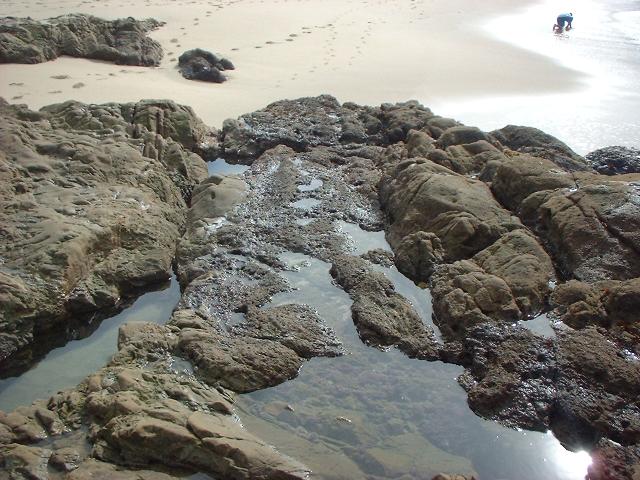
Yeah, we've done that a few times. Seems like we rarely found more than hermit crabs and bits of kelp, but it was always interesting nevertheless. One good place for this was a place that was called "Buggy Beach" (or Buggy's Beach or Buggies Beach – I was never certain, and I think there is a more "official" name), which I think is about here: 55.3083 degrees North, 131.5776 degrees West. This was about the only place near Ketchikan that could be said to have a "beach", though it seems to me that none of the "sand" there was any smaller than pea-sized. That didn't stop the locals from trying to conduct beach activities there – including wading and swimming. At least the water in that little cove was a couple of degrees warmer than other local waters.
Other favorites are at Point Lobos, Point Pinos, and Bean Hollow.
Point Lobos (http://www.zeuscat.com/andrew/personal/photos/2002_carmel_trip/)
Point Pinos (https://hitherandthither.net/point-pinos-tide-pools-monterey/)
Bean Hollow (https://www.parks.ca.gov/?page_id=527)
I remember making you instant coffee in the morning, and it was 3 teaspoons of sugar and one teaspoon of coffee.
No wonder it was so sweet! I've cut way back on the amount of sugar I use; often my coffee has no sugar at all now. I don't necessarily like it better with less sugar — but I believe my health will be better if I consistently use less sugar.
I remember teasing you about having a pocket protector.
pocket protector (https://en.wikipedia.org/wiki/Pocket_protector)
Let's see now, that's supposed to indicate that I'm a nerd or a geek or something. Not only did I have a pocket protector, I used it for its intended purpose. Does that make me both a nerd and a geek?
pocket protector (https://web.archive.org/web/20210120173933/http://www.pocketprotectors.com/)
Unfortunately, nearly all pocket protectors are poorly designed. They were certainly designed in Flatland, but where I live the content of a pocket protector occupies space. If I want to include a couple of writing tools it gets stretched and distorted. Then there's the problem of the pocket itself: not only must the pocket protector fit in there but I'll also need something to write upon, some way to organize receipts and other scraps of paper that accumulate throughout the day, and a small computing machine of some sort. Clearly the pocket protector should be designed as a box or some more complex topology.
Flatland (https://www.gutenberg.org/files/201/201-h/201-h.htm)
So, sadly, most of my geek tools end up hidden in my backpack. It's just so much cooler when you can have them on display in a (pocket) showcase. Alas! my pockets are not that big and there's no pocket protector suited to the task.
I remember when you wrote a story about kids getting lost after we lost Kaylee when she was asleep in my room.
Yes, another adventure it was that day! Kaylee was still a pre-schooler. She had been playing quietly by herself for a little while. Of course most parents know that quiet is not the natural state of children, so when we realized we hadn't seen or heard her in some little while we began to investigate. The younger adults began searching outdoors and visiting the neighbors, while the grandparent types (like me) looked throughout the house. For several anxious minutes we all wandered about calling "Kaylee" loudly and listening for her response.
While we waited for the more distant searchers to return I remembered another time a young child was missing. I sat at my desk and wrote out the story.
A young child was busy playing one warm afternoon while his younger brother and sister were both napping. His mother and his great-uncle noticed the quiet and went to check on him. They went throughout the house and then the neighborhood calling his name — there was no response. As neighbors joined in the search one of them found the missing child, in his own yard, in a cool, shadowed corner of the house where he laid down to rest and had fallen soundly asleep. That child was me, and I was confused when they woke me up; they seemed to be upset about all the anxiety I had caused and at the same time happy to see me safe and healthy.
I finished writing my story at about the same time as the other searchers returned. There was discussion of whether to call the police to assist. I handed Debbie the story to read, and wandered back through the house to look again. Behold! there was Kaylee curled up in a corner of her mother's bedroom, sleeping soundly and totally unaware of the panic her parents had felt.
As we discussed it, we realized that Kaylee's mother, Debbie, as a young child had also been playing in a quiet, out-of-the-way place while her baby sister took a nap. Carol called me to help find the missing older daughter, who was found sleeping under a dresser in her sister's bedroom.
How many times does it take to learn that children who don't respond when they are called are not necessarily absent?
I remember when you made a computer costume for Jamie, and she won a prize at the bank's party.
bank (https://www.firstbankak.com/)
I was working as a computer operator for the bank. They were having a Halloween costume party for the families of bank employees. The party was scheduled during the evening, which was also right in the middle of my shift. Carol had picked up the children from school before starting her delivery route. When she dropped off a shipment at the bank she learned about the party (and that I had forgotten to tell her about it). When the deliveries were all finished she brought the kids, still in costume from the day at school, to the bank for the party. Jamie won the award for the best original costume design.
I remember going to the beach with you in Ketchikan to cut up driftwood to burn in the woodstove.
Yes, the first winter we lived in that house we had very little cash available. The following year we were able to buy heating oil for the furnace so we weren't solely dependent upon the wood stove for heat.
At first I had nothing more than an axe and a bow saw, so getting wood for the stove was a challenge. Carol's father sent us a 16-inch chainsaw a few months later, which improved things immensely. Eventually I had a full complement of firewood tools. I was just a city kid, so our outdoorsman friends had to tell me that burning beach wood was not good for the stove because the salts in it created some sort of corrosive chemicals when it burned. Even when we could get properly seasoned firewood, I still preferred wet beach wood because it didn't burn as hot and burned much longer. Our friends had to tell me about the problems that creates as well (creosote formation in the stovepipe, which can lead to chimney fires).
The beach was about two blocks from our house, down at the end of the road. Actually, our road ended at the street that led up to the highway and it was just a dirt/gravel track that led through the woods about 100 meters down to the beach. On either side of that "road" grew berries — predominantly salmonberries, but also huckleberries and watermelon berries. Even after we moved back into town we sometimes came here to pick berries.
beach (http://mapper.acme.com/?lat=55.447171&long=-131.82231&scale=12&theme=Topo&dot=Yes)
watermelon berries (http://alaskaurbanhippie.com/identifying-wild-edible-watermelon-berries/)
I never make spaghetti in my house, because I only make it when you are eating. I haven't made it in months.
My poor, deprived grandchildren! I'll be right over, put the pot on the stove.
I heard someone say that, during the time you lived with us, you had all the spaghetti you'd ever want. I can't imagine anyone who wouldn't want it at least once a day. It must be nearly the perfect food; prepared properly it contains foods from all the basic food groups (well, perhaps the cheese doesn't count – but we always serve it with a glass of milk).
I remember when we went to the Talbot & McGuire concert in Turlock, and went out for pie afterward.
I remember the concert, but not the pie. I would guess the latter to have been at Latifs's. Sadly, Talbot and McGuire's website seems to be all but dead, but their recorded music is available all over the net.
Latif's (http://www.latifsrestaurant.com/)
Talbot and McGuire (https://web.archive.org/web/20030130190037/http://www.talbotmcguire.com/)
I think one of the reasons I wanted to learn to cook was to cook for you (because you like to eat).
Who doesn't?
Yes it is obvious that I like to eat, and I like to eat what you cook (because you're good at it). But the doctor says my cholesterol levels are too high and I need to lose some weight, and my blood pressure is too high — in other words, I'm just like millions of other American men my age.
So all that yummy stuff they taught you in cooking school made with real butter, heavy cream, and a billion calories per gram just has to stop. Of course, I can still eat as much spaghetti as I want (<wink>, <wink>). However, since you're a thousand miles away now I am at less risk.
I remember when you called Michelle Konet 'Squeaky'.
Yes, she was born prematurely and for at least the fist six months her crying seemed timid and feeble compared to the lusty yowling our children had performed. My nickname for her was "Squeaky" for a very long time afterward — until she started calling me "Uncle Shiny" in reference to my thinning hair. Both nicknames are now retired.
I remember going to the 4th of July parade one year and holding your hand when they weren't throwing candy.
This must certainly have been in Ketchikan. For several of the years we lived there we were in the parade rather than watching, so it most likely was not one of those years. Our first few years there I marveled that anyone was watching the parade because it seemed that surely every resident was in the parade. It must have been visitors — other Alaskans from surrounding communities, and the tourists (those hordes of people who came a thousand at a time from the cruise ships, carrying their umbrellas and cameras and asking if we accepted American money) — who peopled the sidewalks, parking lots, and balconies along the parade route. Odd that these folks always seemed to miss the Christmas parades; we had to provide both the show and the spectators.
Yes there were times we watched the parade, and our children were among the throng that scrambled to scoop up the treats tossed from the various parade units. And when the children were very young, it was only that candy that could entice them to venture away from the security of holding Daddy's hand for a few brief moments. Even the wonder and excitement of a great festival can be intimidating and frightening.
I remember when you sold our car and bought everybody bikes.
I'm trying not to.
It's true though… I did. It seemed to make sense at the time. We lived in a community whose terrain and climate are both very conducive to cycling; we were both working for a non-profit organization, which meant that our salaries were smaller than average; none of us had long commutes to school or work; and we could all benefit from the additional exercise.
I didn't anticipate that our moderately-priced cycles would be so tempting to thieves – even when securely locked up. I didn't anticipate that the stress of riding would aggravate Carol's problem with Kienbock's disease. I didn't anticipate that we'd have a company car available to us most of the time. Nor did I anticipate how difficult it would be to develop and maintain the personal motivation required of each of us to make and sustain such a change in our lifestyles.
Kienbock's disease (http://www.kienbock.com/index.html)
I remember when you came in to wake us up in the morning. You would turn on the light, clap really loud, and yank our covers off.
It worked. Goodness! that sounds rather rude. Have I become more gentle as I age? Probably not; I imagine that I might still resort to such measures if they are effective when kinder, gentler methods aren't.
I remember when Terri made you a computer cake when they lived at Clover Pass.
Yes, she is a resourceful and talented cook. I don't know how she managed to turn those chips and circuit boards into such an attractive and delicious cake.
Actually, I have only the dimmest memory of that cake. I do remember a variety of high-quality foods that she prepared in sometimes quite creative ways.
She was a member of the co-op that purchased bulk lots of grains, legumes, flours, dehydrated milk, molasses, sugar, and other good foodstuffs. She had to meet once or twice a month with other co-op members to divide and repackage the incoming goods and place the orders for their next shipment. I still haven't developed a taste for yoghurt carob granola snacks though.
Terri and Carol made some wonderful breads – I am especially fond of that slightly-sweet light rye – but I think the universal favorite was the cracked-wheat hamburger buns. For a while, neither of our families was interested in hamburgers at all if they did not include those fresh-baked buns.
Oh yeah, we were talking about a birthday cake. I suppose that, since this page is both a collaborative record of shared memories and (at least for me) an exploration of the process of memory itself, it's not a terrible thing to allow some meandering along the way.
I remember how cool it was that you could fold a pirate's hat out of newspaper.
That is kind of cool — especially for the young folks. I wish I could remember how to do it.
Well, that was interesting. I just spent a little while cruising around the Web looking for instructions. Most sites that mention these newspaper pirate's hats seem to assume that everyone already knows how to fold one. That's not surprising for the origami sites, but even the sites that offer thousands of teaching/story/project ideas for teachers and leaders of scouting organizations seem to have the same assumption. It was the Martha Stewart site where I finally found illustrated instructions.
It is much easier to find instructions for folding paper airplanes. I am happy that my own page is among them (though I don't need any help to remember how to fold that one; the children and grandchildren have given me so much practice that I might be able to do it while blindfolded).
James Card - How To Make A Paper Airplane (./airplane/)
I remember when you taught me the proper way to wash dishes
Oh yeah? when was it?
I can't remember when it was, but I do remember that it happened.
I taught you as much as I knew about the subject; which is what my mother taught me years before. Let's see now… hotter water is better, not enough detergent is better than using more than you need, soft plastics (like Tupperware) tend to attract grease so do them first, next the glasses and cups, then silverware (because these things come into direct contact with our mouths), then plates and bowls, finally the pots and pans. There were some vague scientific-sounding explanations about germs and suchlike.
Well, considering that my mother received her Home Economics training in the late 1940s that all sounds about right. She probably got something like "Mrs. Frederick Teaches Women How to Was the Dishes" or "Poetry in Cookery -- HOW TO WASH DISHES" in her classes. "The Right Way to Wash Dishes by Hand" is a more up-to-date (and less detailed) explanation.
Mrs. Frederick Teaches Women How to Was the Dishes (http://historymatters.gmu.edu/d/5569/)
I remember driving arond Monterey eating honey tangerines.
Yes, we lived in Salinas at the time, which was just after we had moved there from Alaska. In Ketchikan, produce was expensive and not nearly the same quality as we get here in California. We had never seen honey tangerines before, so they were a particular treat to us.We were visiting Monterey and I was showing my adoring family some of my favorite places from my high school days there. Now my offspring were about high-school age, and for them this was likely little more than a boring day riding around in the car with their parents.
Right at the edge of New Monterey, just before you cross into Pacific Grove, there used to be a store named "Last Chance Liquors" (which had been founded by Methodists and was, until recent years — okay, within my lifetime — a "dry" town, which prohibited the sale of alcoholic beverages). Not long after Pacific Grove changed their laws this store was replaced by a supermarket.
Pacific Grove (https://web.archive.org/web/20010212053806/http://www.passionfish.net/about_pg.htm)
By the time our Nostalgia Tour reached this supermarket we were ready for some refreshment. We found the honey tangerines and purchased a big bag of them. As the tour continued we each munched more of them than we should have. I remember some of the crew members later complaining that their stomachs hurt and they needed to visit a "comfort station".
I remember when we stuck baked potatoes in our coats to stay warm.
I was working nights at the bank, and my "lunch" break was about midnight. On Friday nights, because there was no school the next day, the whole family (and sometimes some of our friends) came downtown to have lunch with me. Of course Ketchikan had no all-night diners so we had our midnight lunch at one or another of the parks, or even on the dock at the foot of Dock Street. Often we built a fire in the grill and made ourselves a nice hot meal; other times a midnight lunch consisted of sandwiches, chips, and soft drinks.On the occasion that this memory note called to mind we were having a midnight lunch and the menu included foil-wrapped whole potatoes roasted on the grill. The night was unusually cold and some of our party decided they'd rather place the hot potatoes inside their coats than in their tummies.
Those were difficult years; not for me so much, but I've only recently come to appreciate all the effort Carol put into ensuring that we still had some semblance of a family life. I worked most of the night and slept most of the day. I had very little time with the family. Carol also worked, and cared for the children, and still organized things like Friday night picnics. They were fun; and now I look back at them and realize that they are an indicator of a difficult period in our lives. Were we too busy enjoying ourselves to realize how desparate our situation was?
I remember when Jamie asked who cut your bangs. That was so hilarious!
Yeah, back then I still had hair growing near my forehead. But she was only three or fours years old, and apparently was worried that whoever did that to me might try to trim her hair.
Thank you for my love of photography. And "gadgets".
Are you blaming me for your problems again? I'm not sure how much influence I had, but since I also seem to be afflicted with these maladies, and in both cases before you were, I suppose you might have been infected by close contact with me.I hope you continue to enjoy them for a very long time.
I remember when we were having a midnight picnic and a tree in the park burst into flames.
Yes folks in a small town are easily amused, aren't they? It was quite a mystery; as far as I know, no one yet has figured out what caused that fire.
The park is at the top of Bryant street, and a fire station is on the other side of the street at the bottom of the hill. It was faster to walk down to the fire station than try to find a phone to call 911, but the station was all locked up and we had a terrible time rousing anyone there. I think we finally went next door to the nursing home and had someone call the fire department.
We finished our picnic while we watched the fire crew douse the flames. And we had something to remember and talk about years later.
I remember how hard I fought to get my ears pierced, only to discover that you were right all along.
Ah, the old "father knows best" problem. Yeah, that's really annoying isn't it. I've sometimes said that you'd prefer to make your own mistakes rather than learning from others; I suppose I am the same way to some extent.
We've probably both learned from this struggle that there are many other decisions in our lives that are more important than whether to pierce your ears. It seemed so important then and seems so trivial now.
I remember when Jamie and I got locked in the children's Library downstairs, and how glad I was to see you again.
Goodness! I had forgotten all about that. What a traumatic event.
I wish I could remember the circumstance that led to that situation.
The best I can do is to remember that we all often enjoyed visiting the library. The children's section was downstairs, overlooking Ketchikan Creek. Did we assume that you had already gone out to the car? or were you planning to leave the library with someone else? It certainly makes me feel like careless parent, allowing that to happen to you.
Aha! Jamie just explained how it happened: the children's section closed an hour or two before the main library did, and the library staff hadn't noticed the two girls who had been quietly reading in a corner for some time. When I was ready to leave and went to retrieve the children I discovered the children's library was all locked up. I had to find one of the staff who had a key for that door to let them out. Another adventure that was.
I have never been so proud of you than the day that you got your degree.
What a day! I certainly enjoyed those four years of study. I would like to still be in school, but the cash flows of a full-time student are all in the wrong direction; and the fee structures at the university make it prohibitively expensive to take one or two classes at a time as a part-time student.
When I left high school I had had all the school I wanted! The last thing in the world that I wanted to do was to go back to school. When I finally did, I said "well, I've done everything else so I guess going back to school is all that's left."
I encourage you to go back to school too, even if (like me) you have to wait until the children are grown and gone.
I remember when we drove through Cisco, Utah, and you hit that big bump and Jamie peed on my blanket, and we spilled our Root Beer.
We were eastbound on I-70 on our way to Grand Junction when I decided to take a detour through Cisco. It is only a mile or two from the highway and wouldn't add greatly to the length of the trip. We had told the story several times of our first visit to Cisco (on January 1, 1971 -- I finally remembered a date!) and I decided to show you what the place was like.
The road to Cisco was under construction and there was a place where the pavement dropped about five inches. I did not see it in time to slow down properly so we experienced quite a thump when the went over it. The shock of that jolt caused the loss of bladder control, and the "spilled" root beer actually was spraying and gushing out of the small opening in its container. What a mess!
We talked about this event again just last week, and still marvel that, as frightening as that jarring moment was, it was followed by uncontrollable giggling and laughing for several minutes afterward.
I remember sitting in your lap and knowing that absolutely nothing in the world could harm me.
Sadly, about the time you're too old to sit in your dad's lap you begin to realize that statement may be less true than you would hope. Surely every parent has wished they could make it true for their children and grandchildren.
I remember when you swallowed a mouthful of gasoline, and you had a solo at church the next day.
Oh boy! I don't remember the part about singing the next day, but I remember very well swallowing that little bit of gasoline and how its effects lingered for days afterward. Even just thinking of it now makes my stomach feel queasy. I don't remember the occasion clearly but I imagine I needed some gasoline for the chainsaw or to help a friend and thought the easiest way to get it was from the tank in the car.
I remember when you were teaching me to drive in the truck, and I stalled it on San Juan Grade Road, and couldn't make it go for like 10 minutes.
What truck? Oh yeah, my father had his father's old pickup, and we borrowed it. I vaguely remember taking you out to drive on that road but had completely forgotten about the truck stalling. For me this would have been a minor inconvenience, but for you as a new driver it likely seemed a much more emotionally-charged experience ("Oh no! It's all my fault.") and thus more memorable.
©2022 🅭🅯🄏🄎 Attribution-NonCommercial-ShareAlike 4.0 International (CC BY-NC-SA 4.0)
⋯
🗡️ spartan://jdcard.com:3300/ (spartan://jdcard.com:3300/)

